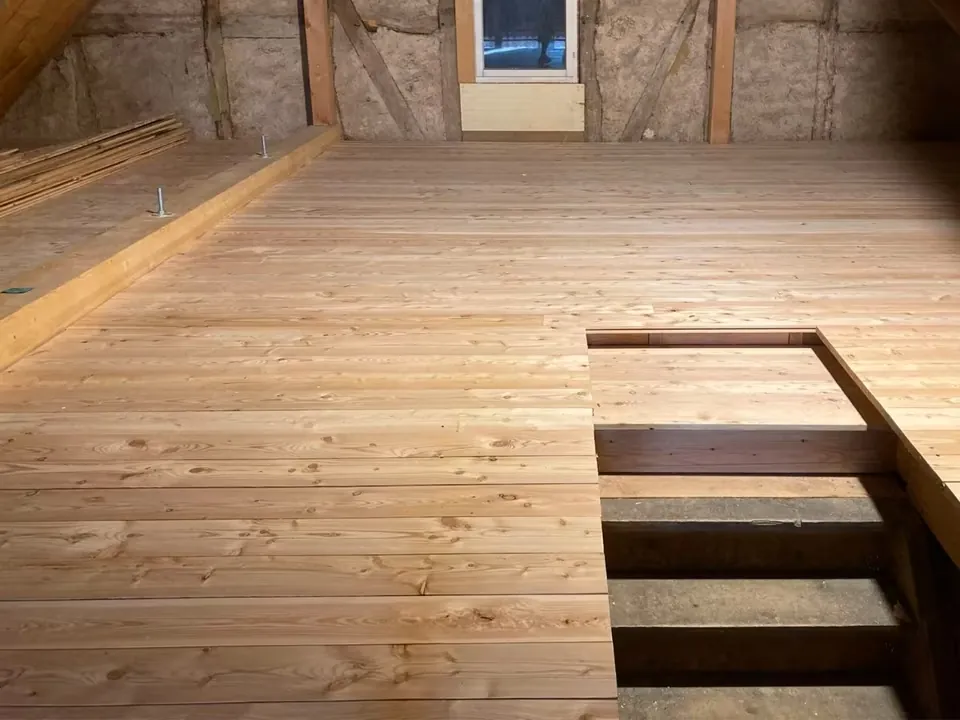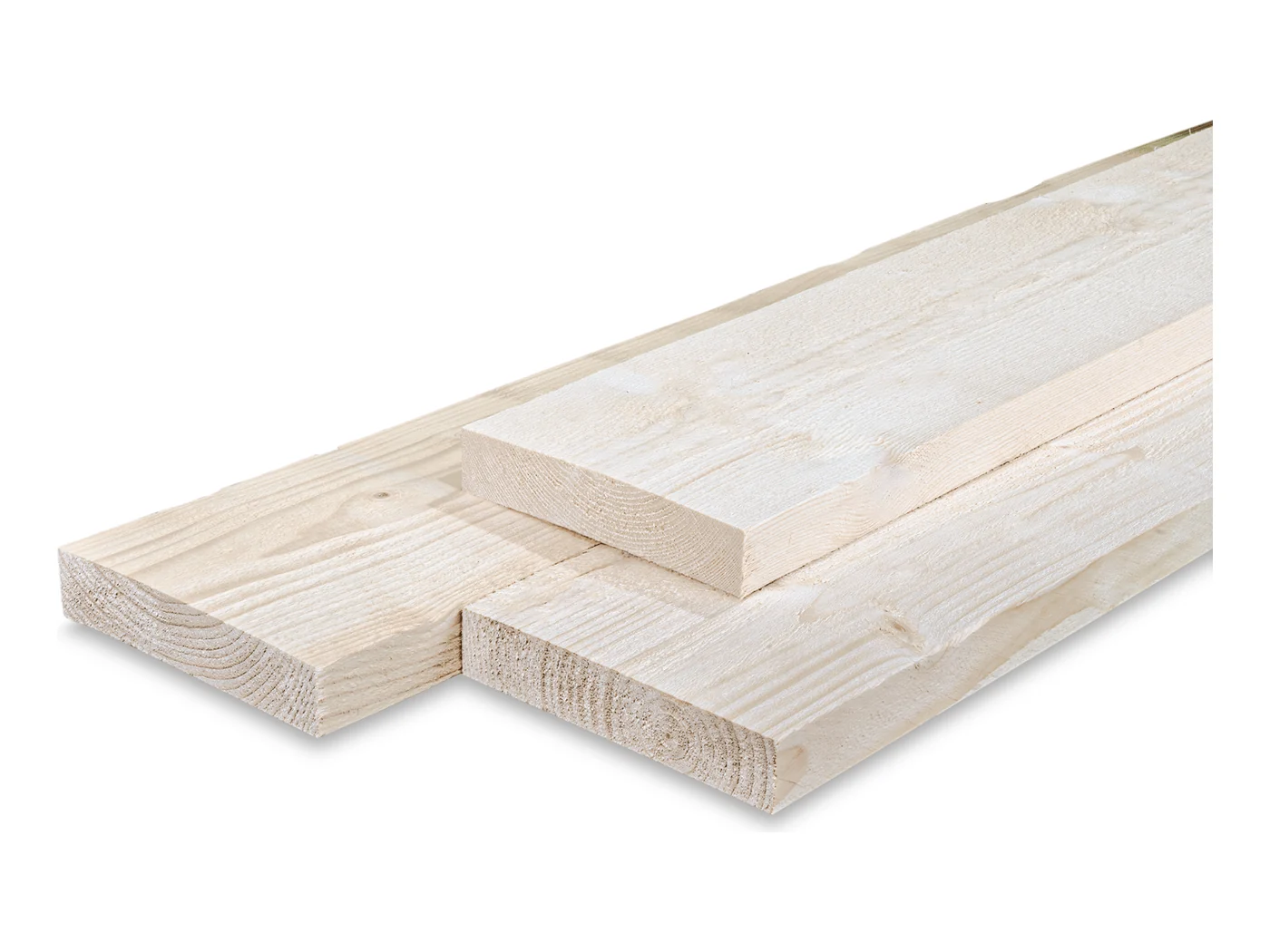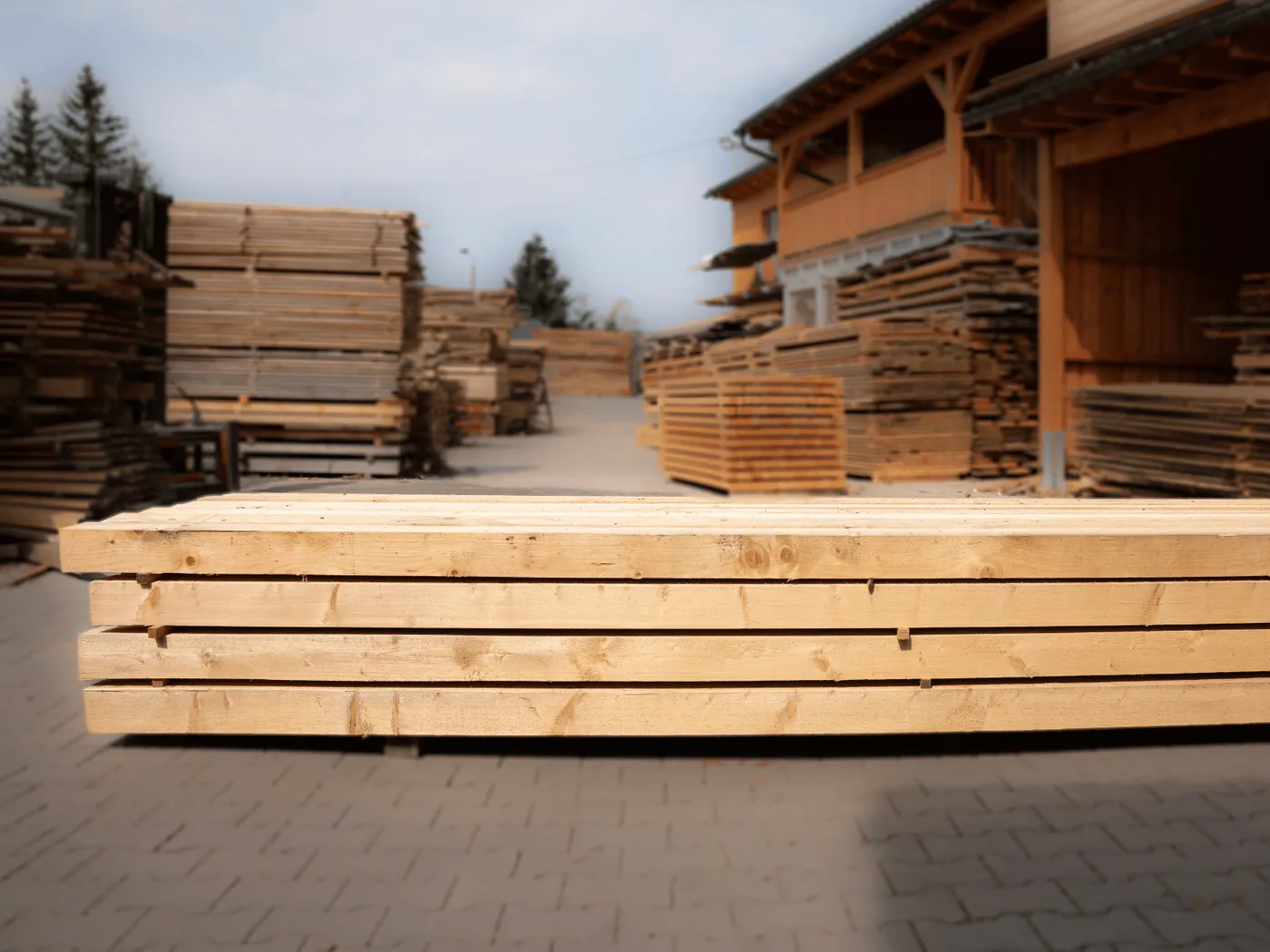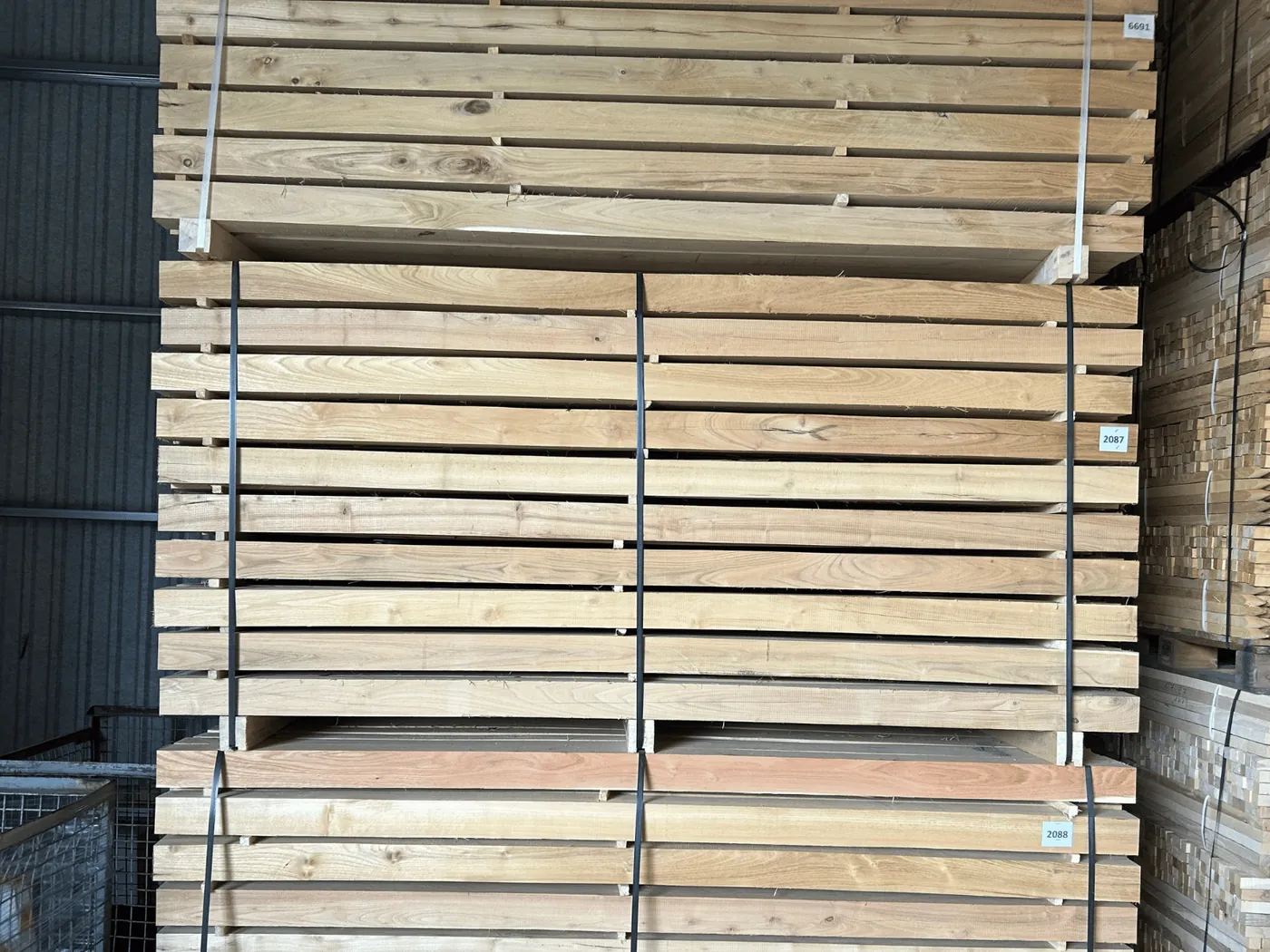
With sawn timber, alongside the timber species, cross-section and surface, the drying condition is often given as well. Terms such as freshly sawn, air-dried or kiln-dried describe different conditions or drying processes and have a direct influence on how much timber can still change after it has been worked.
Moisture content is what matters
What matters here is the moisture content. Timber takes up moisture from its surroundings and gives it off again. Below the fibre saturation range, a change in moisture content also leads to swelling and shrinkage. Which drying condition is possible for which product is given on the pages of the Sawn & Round Timber category.
What does freshly sawn timber mean?
Fresh, or freshly sawn, timber is worked on further or supplied after cutting without prior deliberate drying.
As it then dries, the timber loses moisture. Its dimensions can change as a result. More on this in the guide Sawn size and finished size in sawn timber: what is the difference?. Depending on the timber species, cross-section and course of drying, distortion and drying cracks, for example, can also occur.
That has to be taken into account when planning with oak structural timber or other products from sawn and round timber, for example.
What does air-dried mean?
Air-dried is often designated internationally as AD, air dried. ISO 24294 describes air-dried sawn timber as timber that has been dried by contact with the surrounding air without artificial heating.
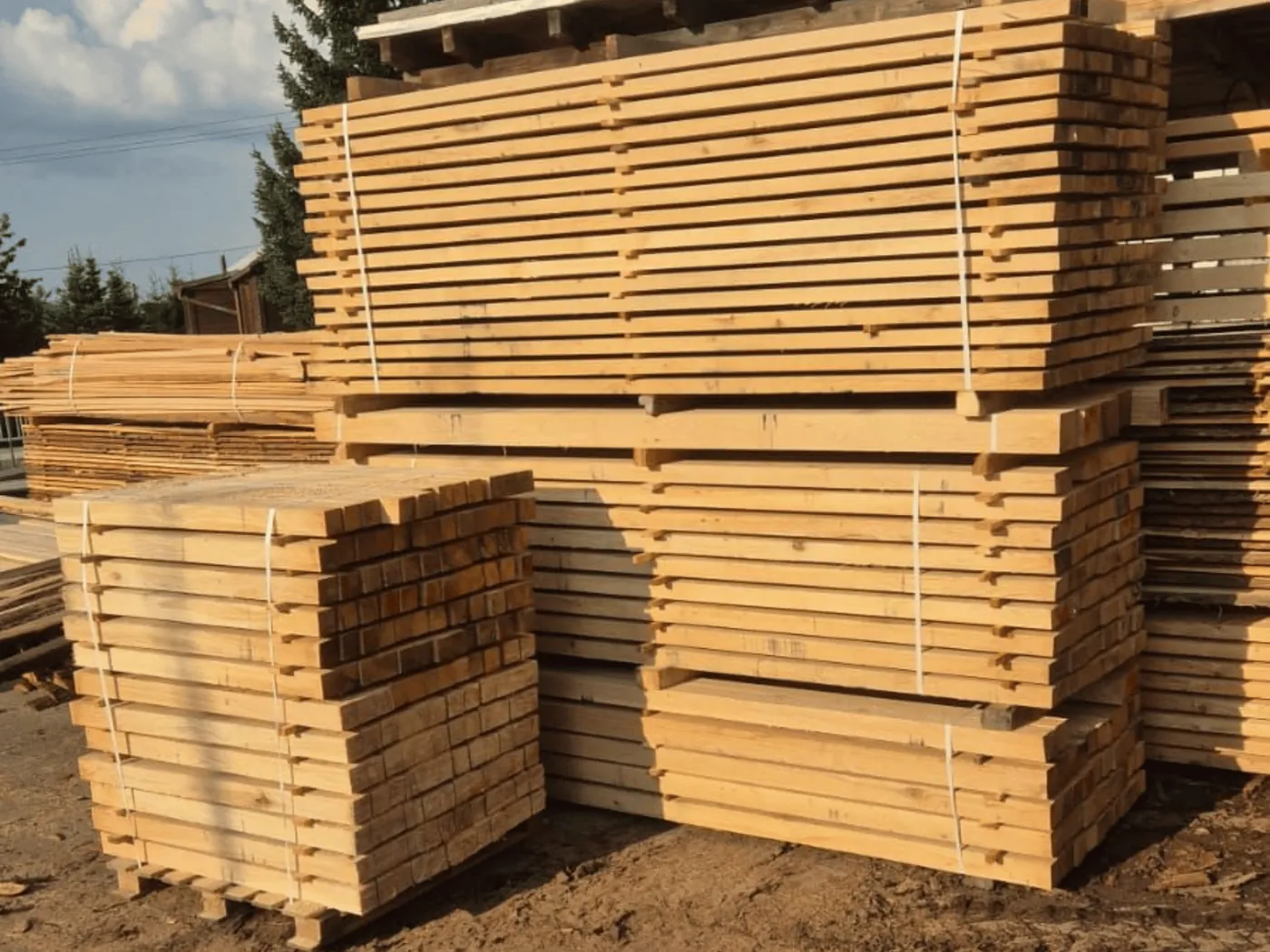
The timber is stacked with spacing battens so that air can flow through the stack and carry moisture away. How far the timber dries and how long that process takes depends strongly on the timber species, the cross-section, the stacking, the season, the temperature, the humidity and the air movement.
Of the two drying processes compared here, air drying is as a rule considerably more time-consuming than kiln drying. Depending on the timber species, thickness and climate, air drying can take several months. Under unfavourable conditions the period can be correspondingly longer.
What matters is this: AD designates the drying process and not automatically a moisture content that is identical everywhere. With pure air drying, the timber approaches the equilibrium moisture content of the surrounding climate in question.
What does kiln-dried mean?
Kiln-dried is often designated KD, kiln dried.
In the drying chamber, the temperature, humidity and air movement in particular can be controlled deliberately. That makes it possible to influence the course of drying considerably more and to reach a desired target moisture content more precisely than with pure air drying.
Kiln-dried does not mean, however, that the timber then stops moving altogether. Timber remains hygroscopic and continues to react to changes in the surrounding climate.
Air drying and kiln drying compared
| Characteristic | Air-dried, AD | Kiln-dried, KD |
|---|---|---|
| Process | Drying by the surrounding air without artificial heating. | Drying in a closed drying chamber under controlled conditions. |
| Duration | Comparatively long and strongly dependent on the climatic conditions. | Considerably faster and more precisely controllable. |
| Controllability | Temperature, humidity and air movement can be influenced only to a limited extent. | Temperature, humidity and air movement can be regulated deliberately. |
| Achievable moisture content | The achievable moisture content is determined substantially by the surrounding climate. | A defined target moisture content can be aimed for more precisely. |
| Energy input | No artificial heating is required for the actual drying. | Additional technical and energy input is required for the plant and the drying process. |
With air drying, the long storage period and the dependence on the weather conditions have to be taken into account above all. Depending on the conditions, cracks, distortion or discolouration, among other things, can occur.
With kiln drying, too, the drying schedule has to suit the timber species and cross-section. Unsuitable or overly aggressive conditions can likewise cause drying damage.
Why is timber sometimes air-dried first?
Air drying can also be used as pre-drying before later kiln drying. Part of the moisture can then be given off by the timber without technical drying.
The essential disadvantage remains the long duration and the dependence on the climatic conditions.
Kiln drying, by contrast, allows considerably faster and better controllable drying. It requires suitable plant and energy.
The most important difference between air drying and kiln drying therefore lies above all in the process, in the duration and in how controllable the drying process is.
Which drying condition is the right one?
That cannot be answered simply with indoors or outdoors.
What matters includes the dimensional accuracy wanted, the later ambient humidity, the timber species and cross-section, the further machining, the surface treatment, the jointing method and the requirements of the specific use.
The more a project depends on defined sizes and controlled further processing, the more important a moisture content to suit is.
How is it with our structural timber?
For our larch structural timber and spruce structural timber, freshly sawn and kiln-dried versions are available. The kiln-dried version is at approx. 18 % ± 2 % moisture content.
Oak structural timber, by contrast, we offer freshly sawn.
Anyone ordering structural timber or sawn timber should therefore always check, alongside the timber species, cross-section and length, which drying condition the goods are offered in and which moisture content the specification refers to.
In brief
- Freshly sawn
The timber was not deliberately dried before delivery. - AD, air dried
The timber was dried by the natural surrounding air. The process is comparatively slow and strongly dependent on the climate. - KD, kiln dried
The timber was dried under control in a drying chamber. The process is faster and considerably better controllable in terms of the drying conditions.
None of these terms means, however, that timber is absolutely dimensionally stable afterwards. Timber remains a hygroscopic material and continues to react to its surroundings.
Technical sources
- ISO 24294:2021, Timber vocabulary, definitions of air dried timber and kiln dried timber
- Holz vom Fach, AD, air dried
- Holz vom Fach, KD, kiln dried
- USDA Forest Products Laboratory, Wood Handbook, Drying and Control of Moisture Content
- Oregon State University, Air and shed drying lumber
- ISO 24294: Timber vocabulary, including the definitions of air-dried and kiln-dried sawn timber
The standards named are a guide; what applies is always the version in force and assessment on the actual object.